
IT for operating businesses
Work written so the business keeps moving.
This page is the work we sell. Legal name and address live in the footer.
The eight headings match our capability sheet. They do not all open on every proposal. In an operating business, IT usually sits in several places at once — endpoints, network, cameras, identity. Which line comes in depends on the inventory from the paid assessment.
The default first paid step is offer A: assessment and roadmap. There are no prices on this site. The assessment turns a broad or partly defined need into a measurable 90-day / 6-month / 12-month plan. Deliverables are a current-state summary, a risk and priority matrix, and a management presentation. Hardware purchase, installation, third-party licences and ongoing support are outside that fee; they are written later as B, C, D or E.
The headings below are not a menu. Implementation (B) after the assessment is a separate project. A monthly support fee or a call-out (C / D) needs written hours and a response window. Procurement (E) does not start until the supplier cost is in. We do not collapse several lines into a single “do all of it” sentence.
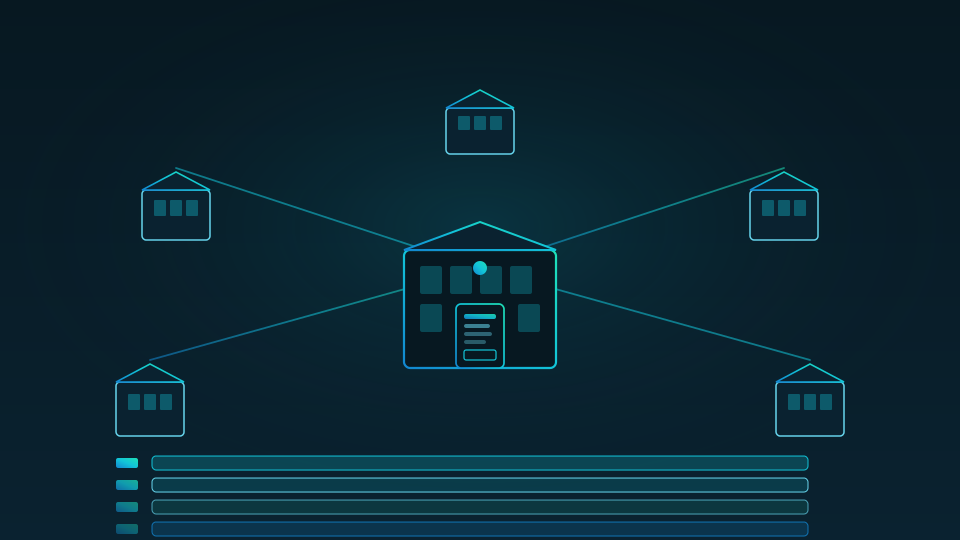
On a six-site operator, offer A does not split each site into a separate “camera job” and a separate “Wi-Fi job.” The inventory is one file: which site, which circuit, which identity, which recorder. Which of the eight headings then open as B or E is written from that file. The longer paragraphs below do not repeat the menu; each line says how the assessment attaches to that work.
To pin down scope, write to info@akillitrakya.com. The fields on the contact page (company, number of sites, user band, need) are enough for a pre-proposal file. Writing is a pre-contract inquiry under the privacy notice.
Service lines
- IT assessment and roadmap
- Systems, servers, and endpoints
- Network, Wi-Fi, firewall, and site infrastructure
- Cloud, Microsoft 365, and identity
- CCTV, ERP, and related business-app IT integration
- On-site and remote IT support
- Hardware and software procurement coordination
- Security, operations, and compliance
IT assessment and roadmap
Purchasing often wants a single line: connect this, quote that. Pricing work that has no written scope as an implementation project is the wrong order. The paid assessment inventories endpoints, servers, network, identity, backup and field systems, and delivers a 90-day / 6-month / 12-month roadmap, a risk matrix, and a management summary. We do not put a fixed price on unclear work outside this phase.
Systems, servers, and endpoints
Endpoint standards and server or virtualization work are planned around the hours the business actually runs. “We’ll cut over at the weekend” has to appear in the proposal as a window, or it collides with the floor. Improvement packages are separate lines; we do not write a large server refresh without the assessment inventory.
Network, Wi-Fi, firewall, and site infrastructure
A coverage complaint at one door is rarely an order for a louder access point. SSID, VLAN, guest access, DHCP, WAN failover and who is on call belong to one operating picture. The plan is written against actual hours and scale; installation is a separate implementation line. We do not price a large refresh from a corridor photograph or a catalogue speed.
Cloud, Microsoft 365, and identity
Identity, access, mail and collaboration have to match how sites actually work. A licence count is not a design: who enters which mailbox, whether leavers are closed, and whether passwords still sit on paper all go into the inventory. Advisory is its own line; we do not write a one-line fixed price that “migrates the tenant.”
CCTV, ERP, and related business-app IT integration
If the recorder sits on a random VLAN, the password is on a sticker, and nobody wrote a retention period, the fault is not the box — it was never part of the environment. Cameras, access control and line-of-business apps belong with network, identity and backup. We support that integration: which VLAN, who watches, how an outage is handled. We do not push a camera brand; procurement runs after funds are in.
On-site and remote IT support
Support is not a promise that a phone call will fix it. We write a monthly fee (retainer) or a signed call-out: hours, response window, out-of-scope work, and travel as their own lines. The on-call number belongs in the proposal. Ongoing run-state work is not inside the assessment fee.
Hardware and software procurement coordination
Hardware and software buying is its own commercial line. One hundred percent of the supplier cost is collected before the order; the service margin is separate. We do not fund the client’s hardware from company cash. Make and model attach to a line in the assessment or implementation proposal — they are not picked as “best value” from a catalogue.
Security, operations, and compliance
Backup, access and basic operational discipline are not a separate “security product” page. Improvement work is written against the ranking in the assessment. “KVKK-aware” on this site means our privacy notice for inbound mail — it is not a promise of legal advice. Backup windows and access lists belong in the contract.
Commercial models (A–E)
No prices here. Each model is a separate proposal. A is the default first step when the work is broad or unclear.
-
A Default first step
Paid IT assessment and roadmap
The default first paid step. We inventory the current environment; deliverables are the roadmap, risk matrix, and management summary. You are buying senior judgment, not a timesheet only.
-
B
Modernization / implementation project
After assessment, or when scope is already tight. Workstreams are split. We do not write a large fixed price before discovery.
-
C
Monthly support / advisory retainer
A monthly support fee (retainer), billed in advance. Hours, response window, and out-of-scope extras are written.
-
D
On-demand on-site support
Signed call-out work. Minimum call-out or half-day; travel is a separate line.
-
E
Procurement coordination
One hundred percent of supplier cost before the order; the service margin is separate. We do not fund the client’s hardware from company cash.