
IT for operating businesses
Wi-Fi is an operations problem
Wireless can look fine on the floor and still be copies of the same SSID, the same password, and a box nobody owns. A fault starts in one room and ends in nobody’s inventory. Wi-Fi is not a hardware order; circuits, wireless, firewall, and the LAN are planned together.
Purchasing often arrives with a corridor photograph or a catalogue speed: no signal at the fourth site, write a louder box. We do not read that sentence as a one-line access-point order. The complaint may be real; the cause is usually a scattered operating picture, not transmit power. The same SSID sits on five doors, the password lives on paper, the guest network leaks onto the staff VLAN, and nobody can say which box is answering DHCP. Who is on call during an outage is not in a proposal.
This note is the reasoning behind the network line on Services. Wireless, the circuit, the firewall, and the LAN go into one file. The deliverable is not a box list. Which SSID goes where, whether guest traffic is split, and who is on call when the circuit drops stay on paper.
Coverage at the fourth site
A “no signal” complaint at the fourth branch is rarely an order for a stronger access point. A shopfront, a till line, and a metal store-room rack will cut a radio; a neighbour site using the same name will cut it too. Ordering one louder box does not end that collision. Pricing an unwritten refresh as a twenty-site fixed price is the wrong purchase order for both sides.
The floor runs on hours. Till close, shift change, and a seasonal store set the measurement window and the cutover window. “We’ll cut over at the weekend” has to appear in the proposal as a window, or install day collides with till close. We do not price a twenty-site refresh from a corridor photograph or a catalogue speed.
When five doors share one name, a device cannot choose which network it joined. When the staff password is shared with guests, guest VLAN traffic reaches the staff printer. When two boxes answer DHCP, the till does not close that day. That picture does not fit a “louder box” line; an implementation proposal does not hold until the operating picture is written.
One operating picture
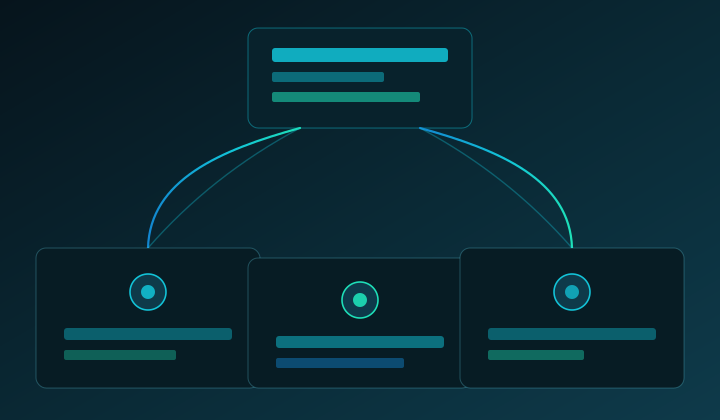
SSID, VLAN, guest versus staff, DHCP, WAN failover, and who is on call belong to the same picture. On a six-site business each door is not a separate “Wi-Fi job.” The inventory is one file: which site, which circuit, which radio plan, which firewall rule, who can sign. The fourth branch is a row in that file.
A radio plan is not SSID names on a wall. Staff, guest, and — where it exists — till or handheld traffic take separate paths; VLAN and firewall rules keep that split. Which box hands out which DHCP range is written down. If two sites share a range, failover produces a clash the moment the spare circuit comes up.
WAN failover is not an annex to wireless. When the branch circuit drops, the till, identity, and the radios drop together. Which location has a spare path, who brings it up, and who is called — those three lines sit in the operating picture. The on-call number does not live in a catalogue; it lives in the proposal.
From the hub it all looks like the same box. From a site it is another password on paper. The assessment puts both views in one file. Missing documents are not ignored; they sit as risk in the next phase.
Assessment first
Pricing unwritten wireless work as an implementation project is the wrong order. The default first paid step is offer A: a paid assessment and roadmap. Deliverables are a current-state summary, a risk and priority matrix, a 90-day / 6-month / 12-month roadmap, and a management presentation. Hardware purchase, installation, third-party licences, and ongoing support sit outside that fee.
The method is on the Approach page; phase titles match the proposal template. Phase 1 narrows scope: how many locations are in this assessment, which are storage or seasonal, whether a cutover window is tied to till close. Phase 2 plans interviews and technical review against site count. Phase 3 classifies risk; “buy this box” becomes a procurement line only after dependencies are written. Phase 4 puts dated bands in the management summary.
Why the paid assessment comes first sets out what A delivers and what stays outside the fee. This note attaches that method to wireless and the branch network. Delivery of the assessment does not automatically open an “install it now” line.
A single-office, single-rack discovery does not hold at this scale. Interviews and the field tour follow the scope note. A crew walking six doors in one pass is not the promise of Phase 2. A signing authority from the hub and at least one site lead at the opening meeting is enough.
Implementation, retainer, call-out
Once scope is tight, modernisation (B) is a separate project. Workstreams split: site backbone, radio plan, firewall rules, cutover window. We do not write a large fixed price before discovery. Installation is not an annex to the assessment; B is written from the items in Phase 4.
Run-state work is its own line. A monthly support fee (retainer) is billed in advance; hours, response window, and out-of-scope extras are written. Signed call-out work (D) runs as needed; a minimum call-out or half-day, travel as a separate line. The on-call number sits in the proposal. Ongoing operations are not inside the assessment fee.
We do not fold B and C into one sentence. After install, “call us and it will be fine” is not an operations contract. Which SSID change is a call-out and which sits inside the monthly fee stays on paper. Otherwise a password reset at the fourth site mixes into the implementation balance.
Support is planned against how sites actually run. A hub rack and a till on a shop floor may not want the same response window. The proposal writes that split. A phone-call promise is not a commercial model until hours, travel, and out-of-scope work sit in the text.
Procurement: cash before the order
Access points, switches, and firewalls are not a catalogue pick. Make and model attach to a line in the assessment or implementation proposal. Procurement (E) is its own commercial line. One hundred percent of the supplier cost is collected before the order; the service margin is separate. The company does not finance customer hardware from its own cash.
“Buy this” written before VLAN, identity, and backup are on paper produces the next outage and the wrong purchase order. Unless the proposal says otherwise, installation and run-state operations are later phases. We do not put a box list in place of the assessment.
Controller software and licences follow the same order. A seat count is not a radio plan. Which site sits under which controller, whether old kits have left the inventory, and whether passwords still live on paper all go into the file. We do not put a one-line fixed price on “we will replace the lot” without that file.
How to write
Write to info@akillitrakya.com to pin down scope. The fields on the Contact page are enough for a pre-proposal file: name, company, number of sites (1 / 2–5 / 6–20 / 20+), user band, need (assessment / implementation / support / procurement / other), a short message, and an optional callback number. Writing is a pre-contract request under the privacy notice. There are no prices on the site; a price sits in a proposal after scope is written.
Write the picture first so the fourth site does not start the day with no coverage.